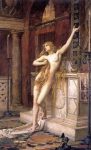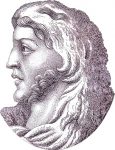
King of the Visigoths. A symbol of barbarism, he plundered Rome, which even Attila had not done and thus earned for himself a place in the annals of barbarism.
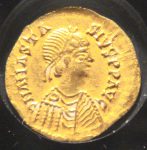
King of the Visigoths. He defended Arian Christianity, but was defeated by Clovis, the king of the Franks and father of Charlemagne, which dealt a fatal blow to Arianism, the doctrine that Christ and God differed in some respects.

Legendary Arab figure. He was reputedly the son of a Bedouin chief and a black slave, who grew up to be a fierce warrior as well as an important Arab poet. The later Romance of Antar portrayed him as an exemplar of the highest Bedouin ideals of courage, hospitality, generosity, and strict adherence to "the code of the desert."
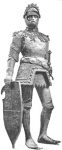
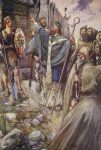
Legendary king. Arthur is said to have valiantly defended his Celtic and Christian realm against pagan Anglo-Saxon invaders. His court at Camelot, with its famous "round table" of dedicated knights drawn from all over Europe, came to represent all the finest ideals of courtly love, of honour, of self-sacrificing service to God, country, and humanity, of knightly chivalry, and of mystical devotion to God's Holy Grail. Although there are references to Arthur by a variety of Medieval writers, the most complete account is Sir Thomas Malory's Le Morte d'Arthur, written in the 15th century nearly a thousand years after Arthur is supposed to have lived.
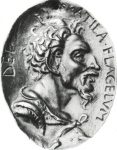
Leader of the Huns. His campaign of terror, conquest, and pillage extended across Europe, although Rome was miraculously saved from sacking by the personal pleas and bribes of Pope Leo I. His gruesome death in bed, possibly murdered by a new wife, is described by Gibbon in The Decline and Fall of the Roman Empire. The name Hun has remained a by-word for barbarism.

Christian bishop, theologian, later Saint. Augustine's starting point is a ringing affirmation of religious faith. ("Credo ut intelligam": "I believe in order to understand.")
He rejects the prodigal life of his youth (not so prodigal by modern standards but including an illegitimate son), a life vividly described and condemned in his Confessions, perhaps the most influential autobiography ever written. He also rejects the Manichaeism (see Manichaeus) of his youth, along with Donatism (see Donatus), Pelagianism (see Pelagius), skepticism, and Platonism (see Plato), although he incorporates elements of Neo-platonic mysticism into his theology. He accepts Aristotle's emphasis on happiness and on virtue as a means to happiness, but identifies virtue with love of God rather than with Aristotle's golden mean.
Augustine's entire thought, notwithstanding its reliance on logic and its sometimes dense metaphysics, including its defense of a doctrine of predestination, may be summarized by his saying: "Love [God] and do what you will."
Critics of St. Augustine charge him with nurturing an alliance between Church and State that leads to and justifies official persecution of non-believers.
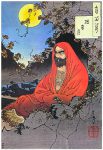
Monk. He traveled from India to China where he met with the Emperor and planted the seeds of Zen Buddhism, emphasizing meditation and intuitive modes of knowledge. From there, Zen spread to Japan where it flourished.
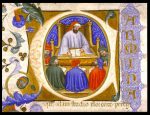
Philosopher and statesman. A powerful figure in Italy, he fell out with the monarch, was imprisoned and tortured to death. He translated Porphyry and Aristotle, giving medieval Europe the classic texts on logic. While in prison, he wrote the Consolation of Philosophy, one of the most famous works of philosophy, which reiterated traditional stoic themes of attaining happiness by reining in the emotions, and especially the emotion of desire.
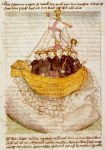
Monk. He was a legendary sea voyager.
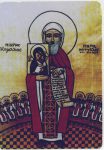
Traveler. A Buddhist monk, he visited Central Asia, Southeast Asia, and India, and left a written account.
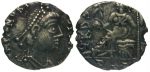
King of the Vandals. He sacked Rome, which led to the term "vandalism."