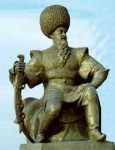
Seljuk (Turkish) leader, devout Muslim, and brilliant military strategist. He wore a burial shroud under his armor when he met a larger Byzantine army at Manzikert in 1071. But he won and secured what became Turkey for Islam.
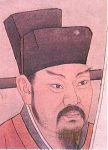
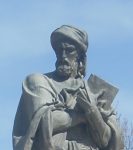
Philosopher and giant of Islamic learning. He wrote on the natural world, medicine, religion, philosophy, and theology, and for a time served as Vizier (first minister of the sovereign) in Persia. His very extensive metaphysics included a logical proof of God's existence which he felt complemented but did not displace revelation as our primary way of knowing about God. His writings on Aristotle were translated into Latin and reintroduced Aristotelianism (with some elements of Neo-Platonism) into Christian Europe.

Priest, early writer in English. He was a father of the language, and wrote Lives of the Saints.
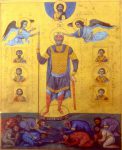
Byzantine emperor. He became infamous for blinding fourteen thousand Bulgar soldiers captured after a battle and sending them home led by one-eyed scouts. Even the Byzantine public, generally inured to ferocity and cruelty, took notice.
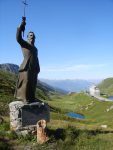
Priest. He sheltered travelers in the Alps. St. Bernard dogs bear his name.
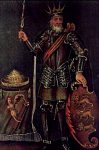
King. He was a uniter of Ireland, and defender against foreign invaders.
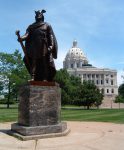
Explorer. He found the coast of North America (Vinland).
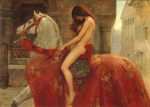
She rode naked in public in order to help others.
Political leader and fighter. He continued the fight against William The Conqueror, won fame for his derring-do, and became a figure of romance.
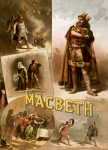
King, Shakespeare made him the ultimate example of misdirected ambition and weakness.
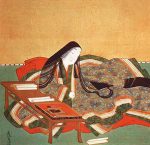
Novelist. One of the earliest novelists, perhaps the earliest, her vast work, The Tale of Genji, describes life in the Heian court of Japan, an extraordinary society in which beauty (whether in nature, architecture, art, poetry, love, dress, or other aspects of ordinary life) was elevated to the highest rung of human values. Was life in this court artificial, cut off from the life and death struggles of ordinary Japanese? Or was it one of the high points of human cultural history? Fortunately Lady Murasaki has preserved it for us and for the ages.
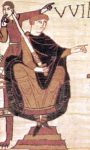
King. He conquered England and created a Norman-ruled feudal system.
